Microsoft Teams Collaboration Integration
- Shipped
- FY26 H1
- Product Design, Product Strategy, Partnerships / Ecosystem, Go-to-Market (GTM), Full-Stack Development
- Microsoft Teams Store app
Overview
As LinkedIn looked to expand the value of its hiring products, we identified an opportunity to build a new track focused on extending the hiring workflow beyond Recruiter. Over FY26, I led design for this track, partnering closely with product and engineering leads to define the strategy and build it from the ground up. The first thing we shipped was a Microsoft Teams integration that made it easier for hiring managers to review candidates and provide feedback.
With a small core team, I worked across the full arc of the product—from defining the strategy and designing the experience to contributing directly to implementation and taking it to market.
Problem
Recruiters can source and evaluate profiles quickly, but often hit a bottleneck when it comes time to get their hiring managers to review these candidates. Feedback is often delayed, fragmented, or never seen, as hiring managers struggle to keep up with requests alongside their other responsibilities. The result is a familiar pattern: recruiters do the work, then wait.
Historically, we tried to solve this by bringing hiring managers into Recruiter, but adoption consistently proved difficult. Hiring managers don’t typically work in Recruiter; their workflow is distributed across email, communication platforms, spreadsheets, and meetings. So we moved on and continued focusing on the parts of the hiring workflow we were already nailing.
As we built AI products to automate more of that workflow, however, this bottleneck became increasingly consequential: automation could only move as quickly as the people around it. It was time to revisit a problem we’d previously set aside.
Opportunity
Rather than bringing hiring managers into Recruiter, we could bring the relevant parts of the hiring workflow into the tools they already use.
Microsoft Teams was a natural starting point. ~350–400K+ Recruiter seats use Teams, representing ~36–41% of Recruiter users across our various product lines. This gave us an established collaboration surface where recruiters and hiring managers could work together—without requiring hiring managers to become Recruiter users.
This gave us a new path to unlock the hiring manager segment we’d struggled to reach through Recruiter itself.
Solution
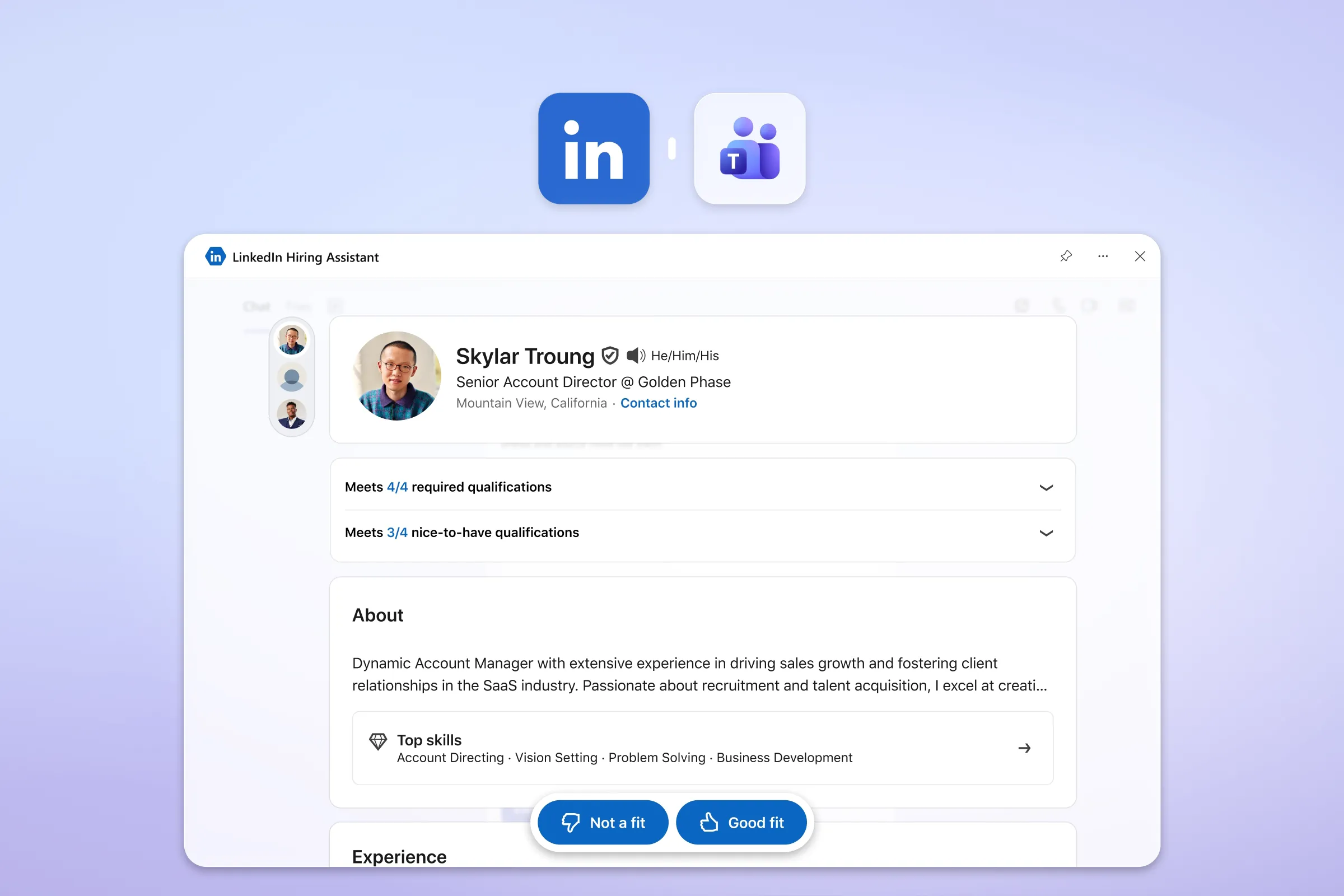
We built a Microsoft Teams integration that gives recruiters and hiring managers a shared workspace for collaborating on requisitions.
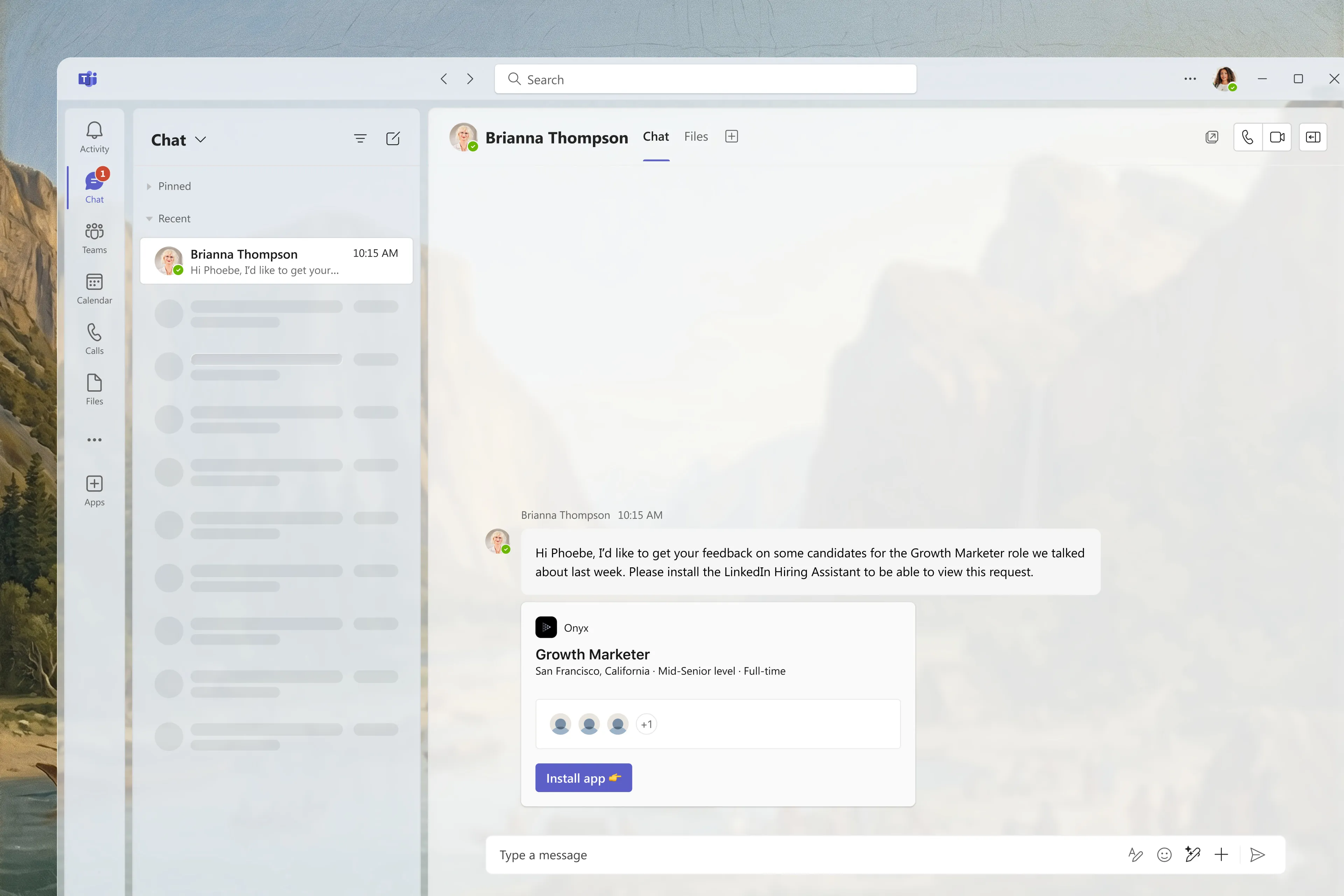
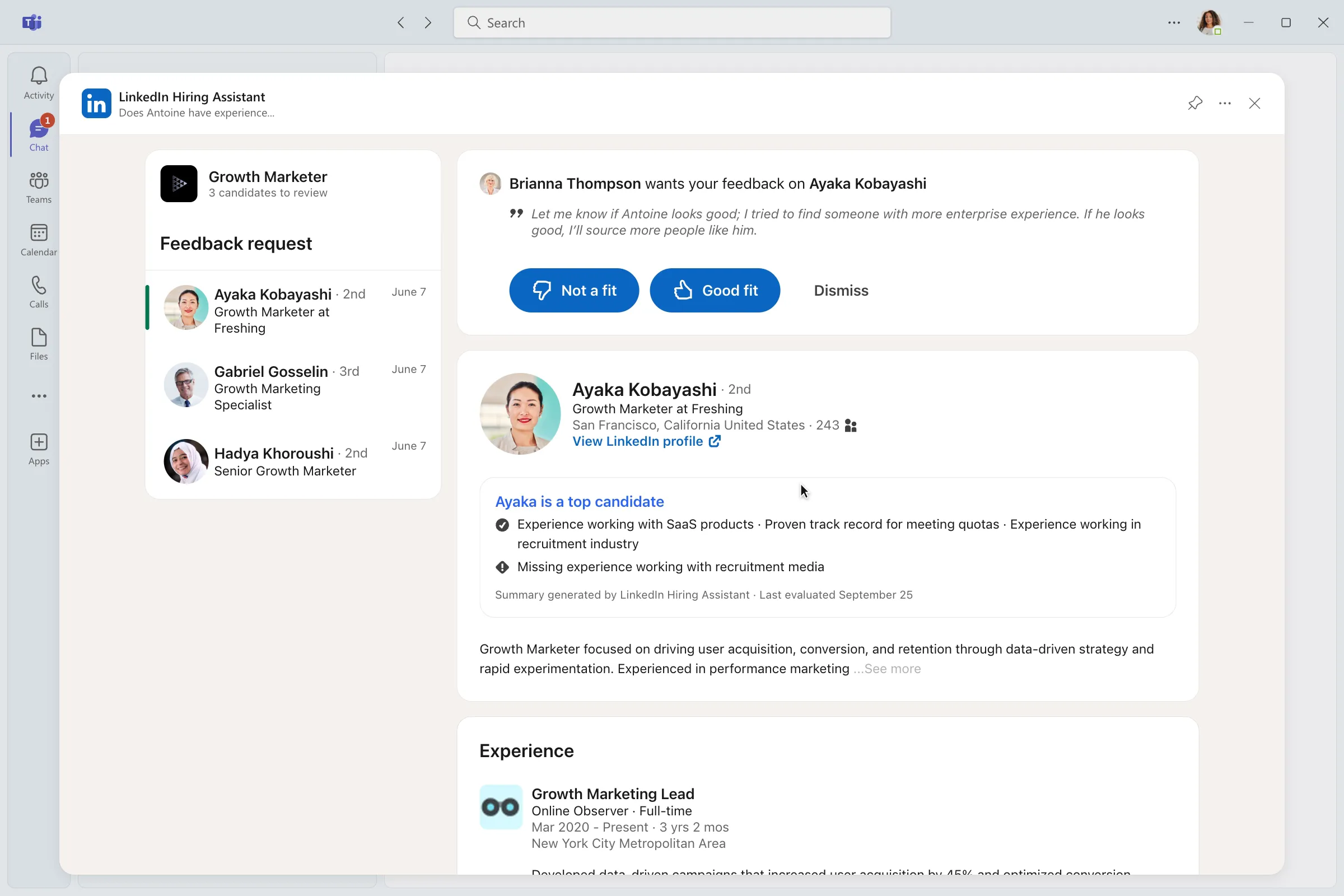
Recruiters can share candidates directly into a dedicated Teams channel, where hiring managers can review profiles, provide feedback, and stay up to date on the hiring process. The experience spans native Teams surfaces and an embedded Recruiter experience, connected through Microsoft Graph APIs.
Designing the integration
Designing the integration meant solving for both sides of the collaboration loop. On the sender side, I expanded the candidate-sharing workflow to include Teams, turning a single-purpose sharing pattern into a scalable system for future integrations and workflows.
On the recipient side, I optimized the embedded Teams experience and its information architecture, making it clear which project and candidates the hiring manager was reviewing. I also designed around the constraints of connecting two separate platforms, accounting for edge cases when Teams and Recruiter couldn’t communicate in real time.
Building the integration
AI-native development accelerated our build cycle and made it possible for me to contribute directly to implementation alongside engineering. Using the Teams SDK, Bot Framework, and Adaptive Cards, we built notification and sign-in flows and customized the embedded experience to surface project-specific candidate context.
Taking the integration to market
After operating at pilot scale, we had clear customer demand, but not enough to hit our targets for GA. The biggest issue was adoption funnel leakage: 70% of requests appeared to go unanswered, but 56% of Teams requests never reached the hiring manager and remained pending. This meant we couldn’t accurately measure the true response rate.
To move toward GA, we needed to close the biggest gaps in the adoption funnel. I drove a set of changes across the customer and product experience: creating new adoption touchpoints with marketing, addressing M365 compliance requirements, and making product improvements to reduce friction.
We also had to revisit some of our original product assumptions and make deliberate tradeoffs to get users to the core value faster. First, we made downloading the Teams app optional for recipients—a sub-optimal experience, but one less gate between the recruiter and hiring manager. Second, we reconsidered gating collaboration behind the platform’s premium add-on. We recognized that optimizing for premium adoption was getting in the way of the core user need, and chose to protect the collaboration experience. In both cases, we prioritized letting users experience the value first, with adoption to follow.
The changes translated into measurable improvement: 68% more Teams requests received a response since June 8, and 67% more customers responded to at least one request.
Final thoughts
This project was particularly meaningful to me because it felt like a startup within a much larger company. Our small core team owned the full arc of the product—from defining the long-term strategy, to taking the first step in a much larger vision, to bringing a 0→1 product to life.
What made it especially challenging was the environment we were building in. Bringing a new experience into Microsoft Teams meant navigating layers of platform requirements, approvals, and certifications alongside the usual product constraints. It was an opportunity to see what it takes to turn an idea into a real product—not just design the experience, but navigate everything required to actually ship it.