Apply with LinkedIn
- In development
- FY25 H1
- Product Design, Product Strategy, Partnerships / Ecosystem, User Research, Prototyping
- Browser-based job application autofill
Overview
I led the 0→1 strategy and design of Apply with LinkedIn—an LLM-powered job application automation product. I defined the end-to-end UX, underlying system design, and how the experience scales across a broader suite of jobseeker AI products.
At the time, LinkedIn was in the early stages of building AI-powered experiences, so this work also helped establish foundational AI patterns in partnership with the design systems team.
Problem
Applying to jobs is high effort, low signal. Each application requires repetitive manual input, even when the same information already exists. While tools have made it easier to apply at scale, they haven’t reduced the underlying friction—or improved how candidates are evaluated—leaving both jobseekers and hirers with high volume and limited signal.
Opportunity
Competitors in the application automation market (e.g., Simplify, Teal) have each grown 3–6x in recent years—validating strong demand—but most still approach this as a form-filling problem. They rely on Chrome extensions that scrape and autofill fields, stopping at submission.
This model is inherently limited. Without access to verified identity, structured data, or ATS integrations, these tools can’t improve application quality or learn from outcomes.
This creates an opportunity to move beyond autofill entirely. With rich member profiles, direct ATS integrations, and a two-sided marketplace, LinkedIn is uniquely positioned to extend application automation into a platform-level system—one that not only simplifies applying, but also improves how candidates are represented and how hiring decisions are made.
Solution
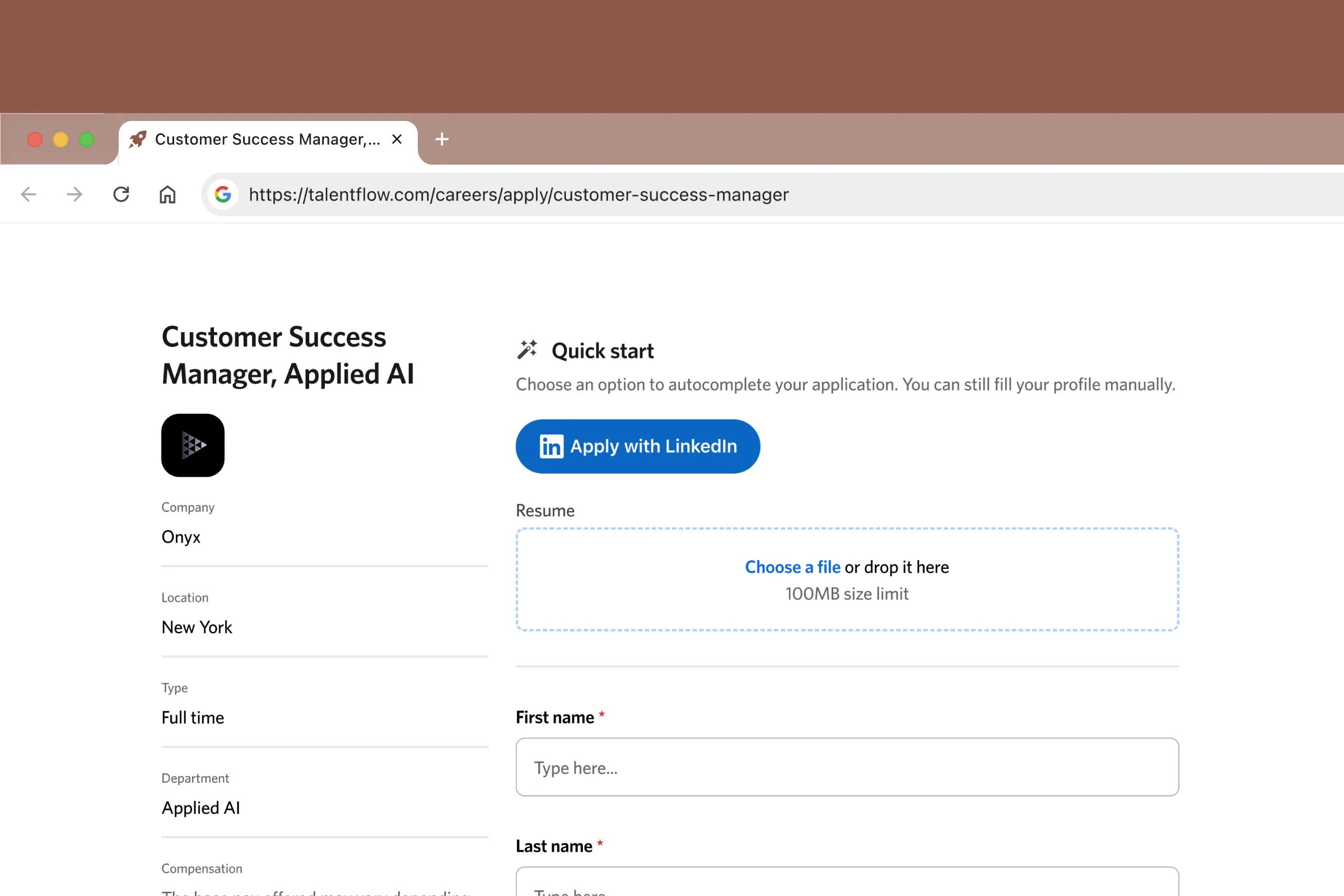
We designed Apply with LinkedIn as an end-to-end application experience that works across external job sites through ATS integrations.
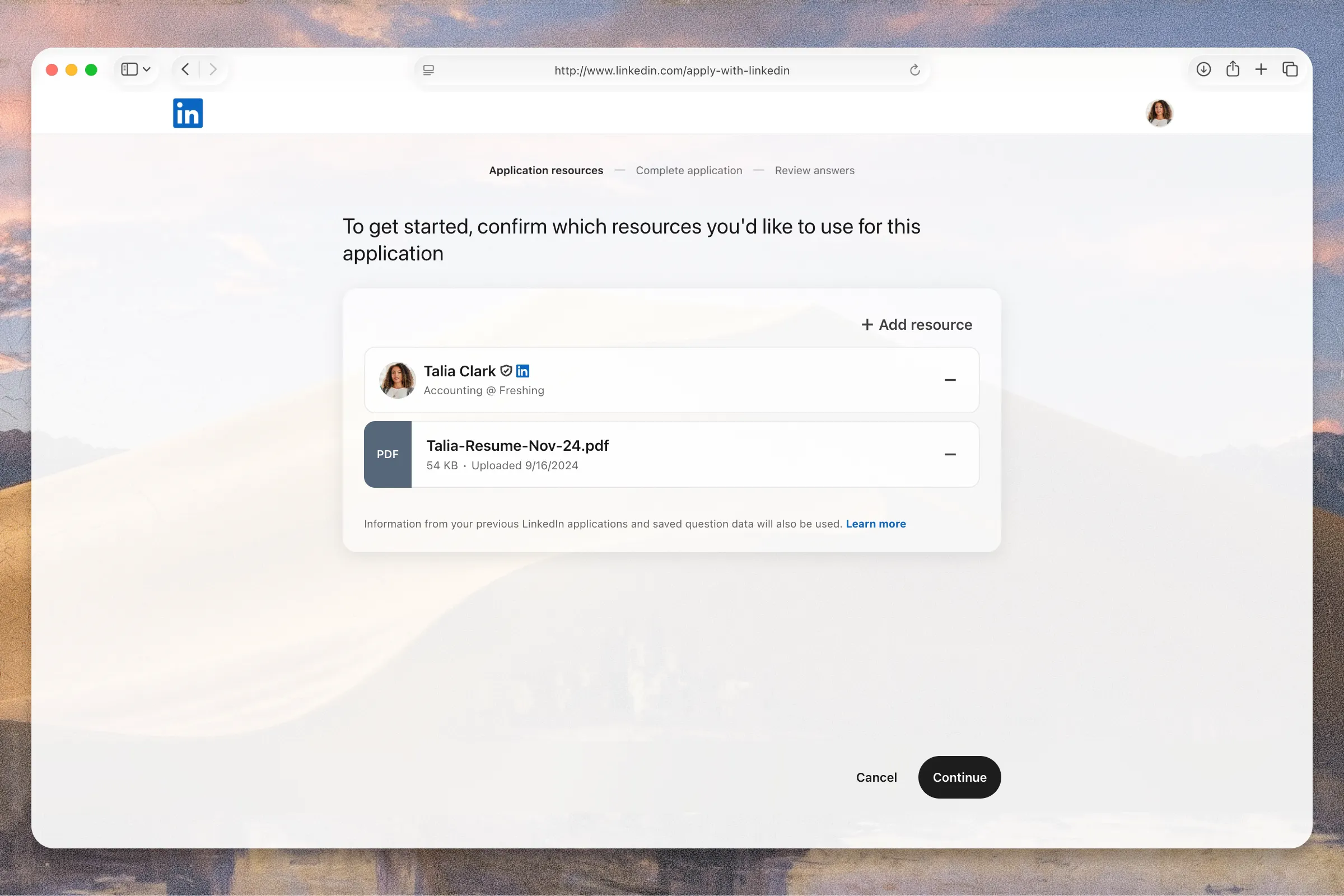
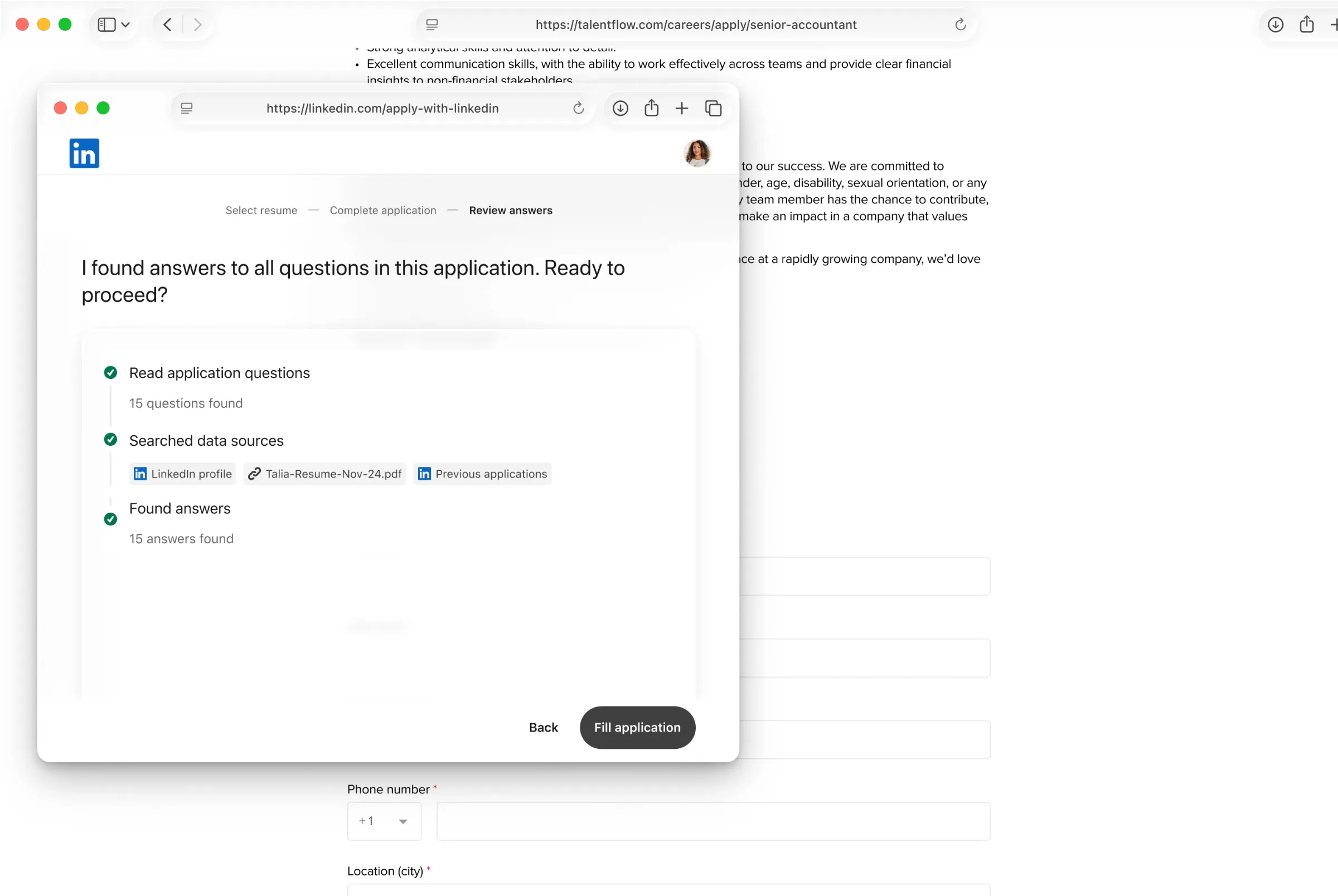
When a member clicks “Apply with LinkedIn,” we use existing data—profile, stored resumes, and past applications—to prefill known fields. From there, the LLM interprets application questions semantically, generates responses where possible, and flags low-confidence or dynamic screening questions for review.
Once submitted, application data feeds back into LinkedIn—powering job tracking, improving future applications, and enabling more relevant recommendations over time.
Choosing the right interaction model
We debated between two approaches: upfront completion, where users have a dedicated onboarding experience to fill in a question bank before applying, and contextual completion, where the LLM fills in what it knows from the data we have about a user as it encounters questions, and the user completes the gaps.
We were uniquely positioned to build either. Our schema-first integrations give us structured questions, field types, and answer options directly from ATS partners, allowing us to build a comprehensive question bank rather than relying on DOM parsing like competitors. At the same time, our LLM could understand questions semantically and answer them in context, making a comprehensive question bank less necessary.
Designing both flows made the tradeoff tangible: we could see how much upfront effort we were asking of users, how often they would encounter questions irrelevant to the application in front of them, and how much information the LLM could defer until it was actually needed. We ultimately chose contextual completion because it created a lighter-weight experience that could adapt to LinkedIn’s global workforce—where applications span industries, career stages, and countries.
Modeling AI confidence
Some questions map directly to structured, first-party data—for example, a candidate’s name or location—where confidence is effectively certain. Others can be answered through semantic reasoning, but require some inference. For example, if an application asks whether a candidate can commute to an office in San Francisco and we know they’re based in San Francisco, the LLM can reasonably infer the answer.
This led me to explore confidence as a design dimension. I mapped different levels of confidence to different interaction patterns: confidently known information could be filled automatically, inferred answers could be surfaced for lightweight confirmation, and uncertain or unsupported answers could be left for the candidate to provide. This gave us a way to balance automation with trust—maximizing how much AI could handle without asking users to blindly accept its assumptions.
Expanding beyond autofill
With the interaction model established, the next question was: what value could we deliver beyond simply filling out forms?
Across all personas—starters, pivoters, and frontline workers—the emotional challenge with job applications is feeling like they don’t know how to stand out, or that the application doesn’t fully represent them. At the same time, hirers face the inverse problem: high application volume with inconsistent quality. As a two-sided marketplace, this created an opportunity to improve outcomes for both sides.
I explored how guidance could be embedded directly into the application flow, helping candidates provide stronger answers in the moments they needed it most. The goal was for Apply with LinkedIn to feel less like a form filler and more like a partner—helping candidates put their best foot forward while giving hirers stronger signals to evaluate.
Closing the loop after apply
The last question I explored was how to connect the end-to-end application experience back to the broader LinkedIn ecosystem. I designed post-apply tracking to give candidates visibility into what happens after they apply, while turning those interactions into signals that could improve the experience beyond the application itself.
Member-side signals feed directly into Jobs You May Be Interested In (JYMBII) ranking and personalization, helping make future recommendations more relevant. At the same time, post-apply data strengthens the value exchange with hiring partners by providing verified, qualified applicant signals in return for hiring outcome data.
Applications become more than a one-time transaction—they become a feedback loop that improves the entire marketplace.
Endnotes
Apply with LinkedIn is currently in development, with a planned launch in FY27. We’ve built an initial prototype to validate the LLM experience and are now scaling it toward production.