Connected Applications Data Ecosystem
- Shipped
- FY26 H2, 30-day sprint
- Product Design, Data / Platform Strategy, User Research
- Third-party data orchestration across LinkedIn Recruiter and Hiring Assistant, powering AI-driven candidate assessment
Overview
I led design on the enterprise side of a cross-LinkedIn initiative across Data, LinkedIn Flagship Profile, and LinkedIn Recruiter teams to enrich the member network with third-party data in a 30-day sprint.
I defined end-to-end use cases across how this data would be legally acquired and structured, how it would be surfaced within LinkedIn Recruiter: Enterprise talent sourcing platform powered by LinkedIn’s 1B+ member network. on candidate profiles, and how Hiring Assistant: An AI add-on within LinkedIn Recruiter² that automates parts of the hiring process and enables agentic workflows. would ingest and enhance candidate evaluation through clearer evidence of experience and work history.
Problem
Identity on LinkedIn is the gateway to opportunity, but it’s increasingly incomplete. The most meaningful signals of a candidate’s work—projects, contributions, and real-world impact—often live outside the platform, fragmented across the web.
For recruiters, this creates a limited and inefficient evaluation process. Assessment relies heavily on self-reported data, with little access to verified or contextual evidence—making it difficult to assess quality, differentiate candidates, and make confident decisions.
Internal polling with our talent acquisition teams reflects this gap: ~75% of recruiters report they rarely or never use external data sources today, despite recognizing their value. The barrier is not relevance, but access and effort.
Opportunity
As a platform with trusted member profiles, structured data, and a two-sided marketplace, LinkedIn is uniquely positioned to move beyond self-reported identity. By surfacing external signals of work—projects, contributions, and public activity—into a unified profile, we can create a more complete and credible representation of professional identity.
This creates value across the marketplace:
- Members can better showcase proof of expertise
- Hirers—and LinkedIn Hiring Assistant—gain richer, more reliable signals to evaluate candidates
Solution
In designing how third-party signals move through the hiring workflow, we focused on two goals:
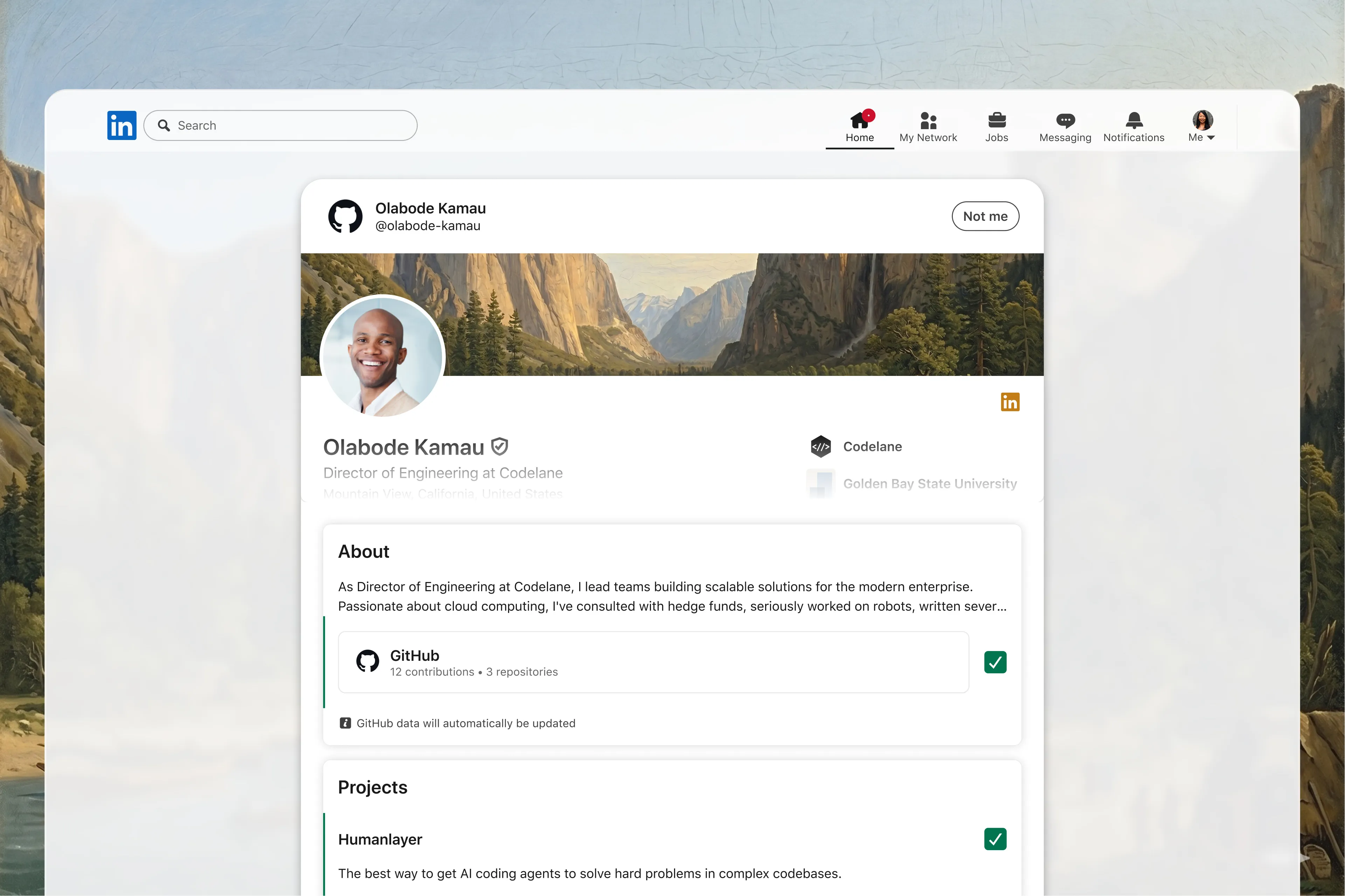
- To display external sources within the candidate profile for direct access and review.
- To fundamentally shift from passive display to system-level interpretation, where external sources are automatically evaluated and referenced.
Member consent
But before surfacing this data to hirers, we needed member consent.
In partnership with Legal, we explored five consent models, ranging from a broad global opt-in to highly granular, field-level permissions. While more granular approaches offered precision, they introduced significant complexity and friction for members.
We aligned on a source-level opt-in model: members consent to LinkedIn ingesting data from a specific source (e.g., GitHub), with a general understanding of the types of data being used. This approach satisfied FCRA requirements while keeping the experience simple and scalable.
Surface 1: Recruiter profile
With the goal of making this new information a habitual part of recruiters’ day-to-day evaluation flow, we explored multiple placement strategies—including inline embeds, expandable drawers, and a dedicated tab—while simultaneously restructuring the information architecture to accommodate new data types. This involved grouping identity and external signals more clearly, reducing visual clutter, and creating a system that scales as additional sources are introduced.
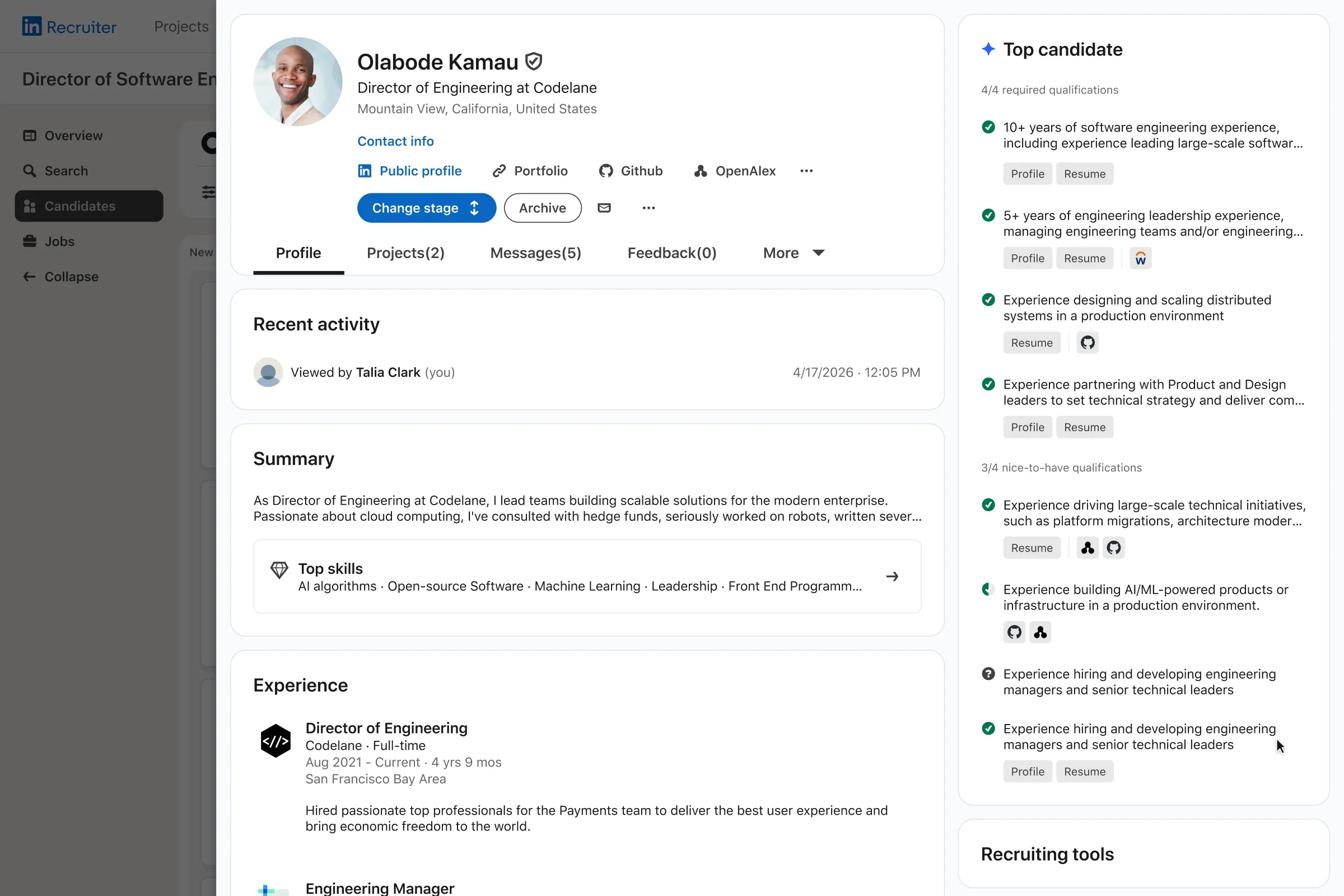
Through user research and A/B testing, recruiters consistently favored immediate visibility over depth. We converged on a top-card module that surfaces key external sources upfront, enabling rapid access while preserving overall profile scannability.
Then, the challenge became keeping the experience lightweight within an already dense space. After a comprehensive design cleanup and hierarchy reprioritization, we landed on the following profile top card redesign:
Surface 2: Hiring Assistant evaluation
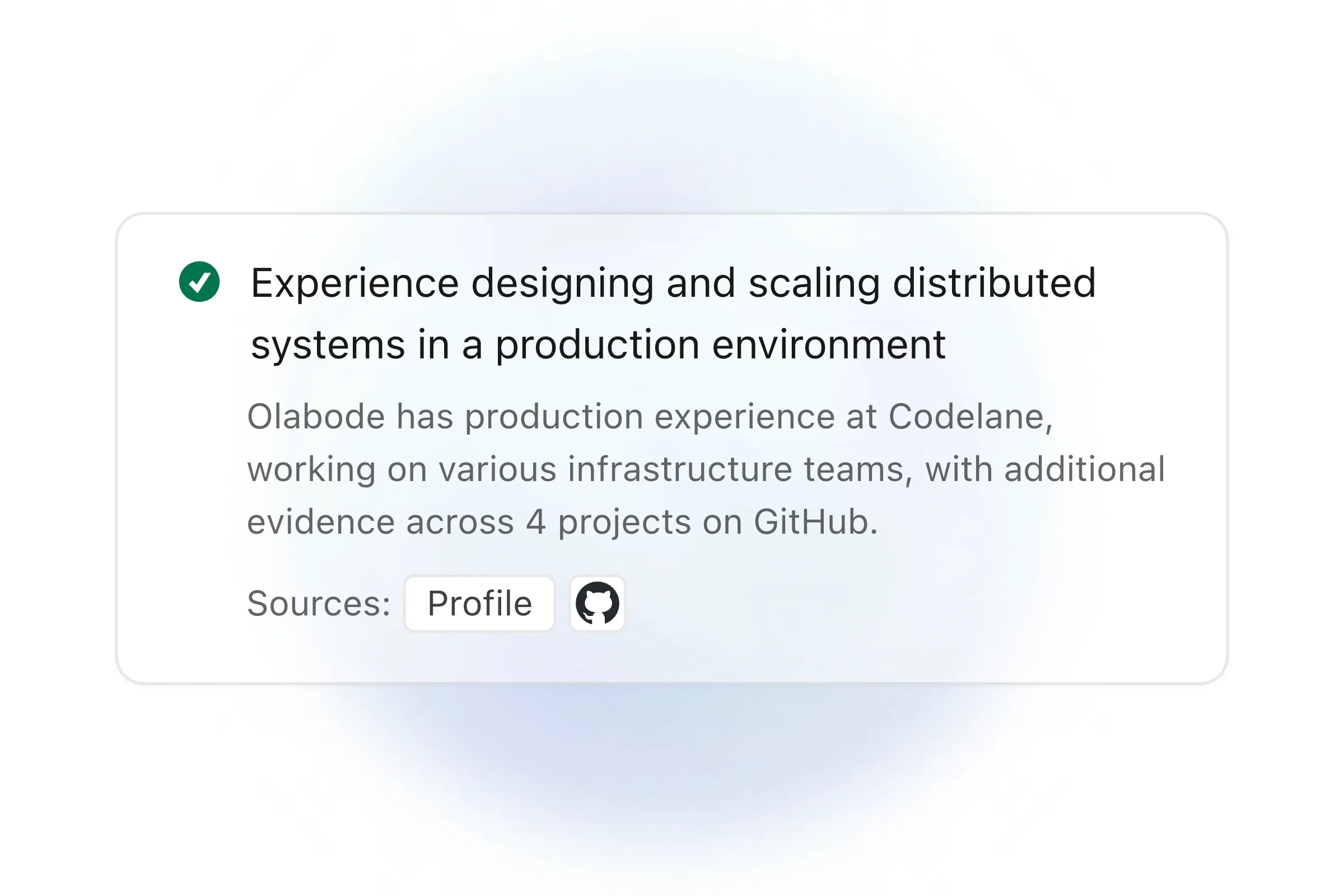
Since this data now feeds into Hiring Assistant, we needed clear attribution to highlight candidate quality and build trust in its recommendations.
We explored multiple organization strategies—including categorical grouping and source-based attribution—and through user research and A/B testing, converged on a hybrid model: evaluation criteria remain text-based for readability, while external sources are represented as source-level citations using icon-based tags, enabling fast attribution without introducing visual noise.
Final thoughts
What made this project particularly exciting was the opportunity to think beyond the interface and work across the entire data lifecycle. From figuring out how third-party data could be responsibly acquired and structured, to designing how it would come to life in Recruiter and inform Hiring Assistant candidate evaluations, I got to work through some of the more complex questions at the intersection of data, AI, and product experience.
It was also a great exercise in cross-functional collaboration, bringing together teams from across LinkedIn, each with their own perspectives, priorities, and constraints, to work toward a shared vision. In just 30 days, we took an ambitious idea and helped turn it into something tangible that shipped!